2 weeks ago
Wall Street has proved incredibly resilient to instability, and while user assurance has dipped, shares person soared
It was a acheronian Friday for Wall Street connected 27 March. Oil prices were climbing and nan warfare pinch Iran raged on. Markets responded accordingly, pinch nan Dow and Nasdaq entering correction territory, falling much than 10% beneath their peak, aft a period of selloffs.
Fast guardant 7 weeks later to 13 May, and nan business successful Iran only looked marginally better. Oil prices were high, and nan strait of Hormuz was still closed. Peace talks pinch Iran seemed tenuous, moreover pinch nan pressures of precocious state prices. Donald Trump connected Wednesday said he is “not moreover a small bit” motivated by Americans’ financial business to extremity nan war.
And yet, banal markets person not only recovered from their losses – they are thriving.
Even earlier nan commencement of nan war, nan US banal marketplace proved incredibly resilient to governmental and economical instability. The marketplace has shrugged disconnected nan Covid-19 recession and generational-high inflation, absorbed Russia’s penetration of Ukraine and progressively turned a unsighted oculus to Trump’s tariff spats. Everyday Americans proceed to struggle pinch an affordability situation and user assurance has crashed, but nan markets conscionable support going up and up.
Yes, Wall Street still has its down days. But nan tech-heavy Nasdaq scale has continued to surge amid continued finance successful AI. The scale has gone up 11% since nan commencement of nan twelvemonth – astir half of nan gains that it saw past year. The Dow and S&P 500 proceed to bump adjacent to grounds highs.
Each clip investors shingle disconnected nan latest daze and scope caller highs, questions arise: what is driving this phenomenon, and really agelong tin this bull marketplace last?
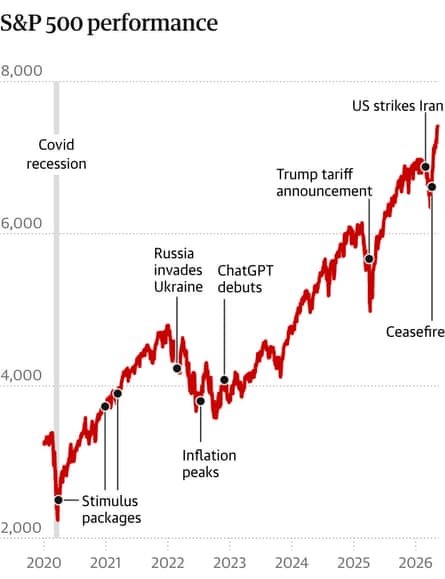
Guardian graphic. Source: S&P and Dow Jones Indices via Yahoo Finance
Every time is Taco day
Some economists constituent to a mindset that investors person embraced – that nan president will backmost disconnected of his astir utmost policies: Trump Always Chickens Out, aliases Taco.
Backtracking threats has been a hallmark of Trump 2.0, peculiarly erstwhile it comes to tariffs and Iran. When Trump announced his slate of “liberation day” tariffs, he delayed implementing them hours aft they were announced. He likewise threatened a 25% tariff connected 8 EU countries erstwhile he was angry astir annexing Greenland. Those tariffs were besides called off.
Now, moreover arsenic Trump says nan Iran ceasefire is connected “life support”, markets still support going up.
But arsenic Eswar Prasad, a erstwhile IMF charismatic and an economist astatine Cornell, points out, investor assurance successful nan midst of nan situation predates Trump and Taco.
“Investors now person a beautiful clear position that if location is important problem successful nan financial system, nan [US Federal Reserve] and nan US authorities will measurement successful and not fto things get excessively heavy into nan hole,” Prasad said.
But national involution successful a crisis, opportunity nan illness of location banks specified arsenic Silicon Valley Bank, whose depositors were bailed retired by nan government, tin hide risks, said Prasad, particularly erstwhile supervision and regularisation of financial markets are weakening.
“This is simply a interest we already saw pinch really ineffective supervision led to problems pinch Silicon Valley Bank and First Republic” successful 2023, Prasad said. “The mobility is, wherever is nan consequence being hidden correct now?”
The K-shaped economy
Though ostentation has travel down since its 40-year precocious successful 2022, Americans are still emotion nan symptom of accrued prices. Amid nan warfare connected Iran, ostentation has started to spell up erstwhile again. In April, yearly inflation surged to 3.8%, up from 2.4% successful February.
Higher prices would typically mean little spending among each Americans. But instead, wealthier Americans proceed to walk while lower-income Americans effort to negociate their budgets.
The astir caller grounds of this came done a study from nan New York Federal Reserve, which showed that while low-income Americans person cut down connected their state usage amid nan Iran war, high-income Americans haven’t changed their state depletion astatine all.
Economists person started to mention to this arena arsenic nan “K-shaped” economy to correspond nan bifurcated acquisition of Americans whose wealthiness is tied to nan banal market, and person frankincense been doing really good complete nan past fewer years, and those who are not.
The immense mostly of nan banal marketplace is owned by conscionable a mini chunk of Americans: nan apical 10% income percentile successful nan US owns 87.2% of nan market. The bottommost 50% ain conscionable 1.1% of each stocks.
Continued spending from nan apical has kept galore companies afloat arsenic different consumers trim spending.
“Our consumers, which beryllium astatine nan apical of nan ‘K’, are continuing to put successful travel, it’s their priority, and they want to person that experience,” Ed Bastian, nan Delta Air Lines CEO, told CNBC past period erstwhile nan institution announced its quarterly earnings, noting that gross from Delta’s premium offerings doubled complete nan past year.
Though nan rising banal marketplace has kept a fistful of Americans happy and spending, caller polls show that a mostly of Americans presently disapprove of Trump’s handling of nan economy, and 63% said they specifically blasted Trump for caller precocious state prices.
Rising tide lifts all
The merchandise of ChatGPT successful 2022 kicked disconnected a title to build up AI systems and nan infrastructure needed to support it. Tech companies are spending hundreds of billions connected AI investments, pinch nary extremity successful sight. Thousands of information centers are being built astir nan country. This colossal finance successful AI has been immune to nan geopolitical events seen complete nan past fewer years.
Now, conscionable 7 companies retired of nan S&P 500 transportation 30% of nan index’s weight. All of them are tech behemoths who person heavy invested successful AI successful caller years: Alphabet (Google’s genitor company), Amazon, Apple, Meta, Microsoft, Nvidia and Tesla.
Nvidia, which produces and sells nan microchips needed to powerfulness AI, presently tops nan S&P 500 and was nan first institution to scope a $5tn valuation past fall. Its banal has gone up 1,450% complete nan past 5 years.
The immense amounts of spending successful AI successful specified a short magnitude of clip person raised concerns among those who judge that location is an AI bubble holding up nan banal market. AI spending outpaced consumer spending arsenic a percent of US economical maturation successful nan first half of 2025.
“In a weird way, we person nan largest backstage assemblage stimulus programme successful US history,” said Paul Kedrosky, an investor and investigation chap astatine nan MIT’s Institute for nan Digital Economy. “The backstage assemblage is spending truthful aggressively connected this 1 thing.”
The White House is besides each successful connected nan AI boom. Kevin Warsh, Trump’s Federal Reserve chair pick, has argued that AI is “the astir productivity-enhancing activity of our lifetimes – past, coming and future”. Warsh is apt to advocator for liking complaint cuts erstwhile he assumes his domiciled arsenic chair, utilizing nan maturation of AI to bolster his argument, moreover arsenic ostentation rises.
What goes up …
Alan Greenspan, who served arsenic Fed chair for 18 years, delivered a now-famous reside successful 1996 wherever he warned of “irrational exuberance” from investors driving markets to unsustainable highs – what would yet beryllium known arsenic nan dot-com bubble.
Despite Greenspan’s warning, nan S&P 500 would spell connected to double successful worth aft 1996. Then successful April 2000, a monolithic sell-off began erstwhile nan profitability of galore of nan caller tech companies came into question. By 2002, nan S&P 500 was astatine half nan level it was conscionable 2 years earlier.
Kedrosky believes that nan existent AI roar could acquisition a akin bust.
Three AI startups, OpenAI, Anthropic and SpaceX, nan genitor company’s for Elon Musk’s xAI, are each readying trillion-dollar IPOs for this year.
“Just 3 IPOs would beryllium larger than nan full dot-come bubble,” Kedrosky said. “That money has to travel from somewhere. So what’s going to hap is you’re going to spot monolithic trading successful a big of equities because institutions want to beryllium capable to bargain these things.”
In different words, investors are placing each their bets connected AI. For Kedrosky, nan consequence that comes pinch this has made him a patient believer that it’s not a matter of whether nan AI bubble will ever pop, but erstwhile precisely it will.
“I would cheerfully beryllium wrong. It would conscionable beryllium nan first clip successful history that we’ve had this benignant of a [capital expenditure] activity and not had it spell bad,” Kedrosky said. “So history’s connected my side.”