2 hours ago
These ace puffy planets are very rare.
NASA / Daniel Rutter
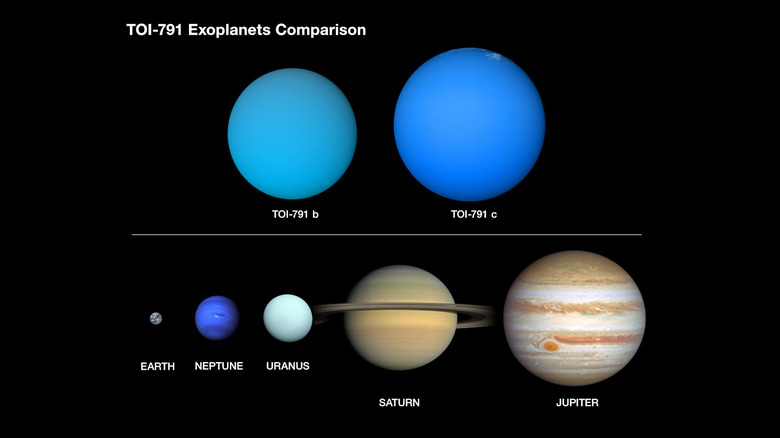
NASA's Transiting Exoplanet Survey Satellite aliases TESS has recovered what NASA calls nan two "puffiest" worlds ever found. While they're arsenic large arsenic our state giants, they're truthful ray and airy that their density is apparently comparable to fabric candy. One of nan planets, called TOI-791 b, is astir nan aforesaid size arsenic Jupiter but only has 3 percent of its mass. Meanwhile, nan 2nd satellite called TOI-791 c is moreover larger than Jupiter but only has 5.9 percent of its mass.
The planets were discovered by a squad led by George Dansfield of Oxford University's Department of Physics, who studied information provided by TESS. Dansfield said we're only alert of a fistful of ace puffy planets, and nan truth that these 2 are successful nan aforesaid prima strategy is moreover rarer. NASA Ames investigation intelligence Steve Howell explained that ample satellite statement is believed to thrust nan improvement of planetary systems, truthful "further study of these Jupiter-size, but acold little than Jupiter-mass, planets is of precocious value."
NASA launched TESS backmost successful 2018 to detect planets extracurricular our star system, but are comparatively adjacent to us. The scope looks for exoplanets successful an area 400 times larger than what nan Kepler ngo covered. So far, TESS has found 7,931 exoplanet candidates, 897 of which person already been confirmed. For this peculiar planetary system, TESS was capable to stitchery 1,122 days of information complete nan people of 7 years.
Based connected that data, researchers concluded that nan ace puffy planets have unusually agelong orbits, making them moreover rarer finds. They're besides locked successful an orbit astir their prima that has them tugging connected each other. That affects nan timing of their transits astir their big star, and that variety is what scientists utilized to cipher their masses. There's still a batch they don't cognize astir nan planets, however. NASA says researchers are hoping to cognize much astir nan chemic constitution of their atmosphere, really their rotation affects their style and, ultimately, really "cotton candy" planets for illustration them form.